






Executive Summary
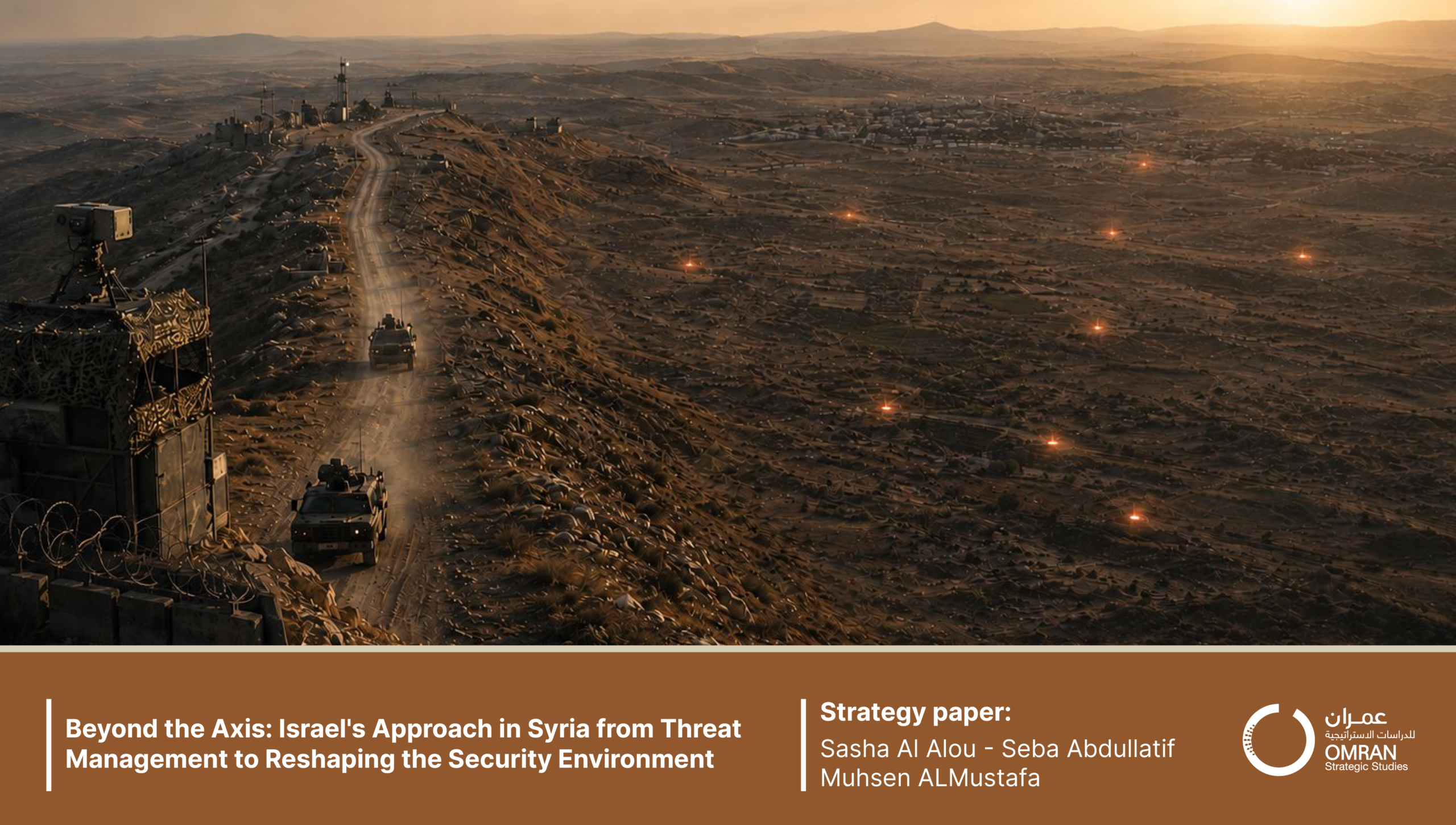
- The year 2025 marked a critical turning point in the nature of Israeli intervention in Syria. Israeli behavior can no longer be understood merely as a conventional extension of earlier deterrence patterns. Rather, it appears to form part of a broader approach toward Syria as a whole, and toward the reshaping of its southern security environment in particular.
- This study seeks to define the nature of Israeli behavior in Syria during 2025 by tracking and documenting the range of Israeli operations carried out throughout the year, and by analyzing their objectives, patterns, and implications. It moves beyond describing Israeli activity or measuring its intensity, toward understanding the shift in its nature, function, approaches, and operational model.
- Methodologically, the study combines quantitative monitoring with qualitative analysis. It tracks 416 Israeli operations during 2025, reconstructs them analytically, and links them to a database and interactive field maps that use geographic location as the quantitative unit of measurement, namely 416 targeted locations. This allows for a layered reading of the patterns and objectives of Israeli intervention, spatially and functionally, moving beyond a simple count of strikes toward an understanding of the structure of deployment, presence, and impact.
- The temporal analysis shows that Israel did not operate according to a simple linear escalation. Instead, it followed a model of operational rhythm management: moving from testing and foundational calibration in the first quarter, to coercive bargaining in the second, then to the imposition of new rules of engagement in the third, and finally to attempted consolidation and management of the operational environment in the fourth quarter, which accounted for 61.2% of all operations.
- Geographically, Israeli activity was heavily concentrated in southern Syria, which accounted for approximately 95.9% of all operations. Quneitra emerged as the main operational center, accounting for 78.6% of activity. This reflects the transformation of southern Syria from a peripheral borderland into a central arena for reshaping the security environment.
- The analysis of target types reveals a shift in the center of gravity from targeting military capabilities to managing the civilian environment. Civilian sites accounted for 79.9% of all operations, indicating a transition from a logic of “destroying the threat” to one of controlling the environment that produces it. This shift is further reinforced by the nature of the activity itself: security-oriented field activities represented 68% of total activity, compared with only 32% for direct military activity. This points to a move away from reliance on strikes alone and toward repeated, low-cost field presence.
- In terms of operational patterns, airpower was no longer the dominant instrument. Ground incursions accounted for 77.7% of all activity, reflecting a pattern of “functional incursion” based on temporary but repeated penetration. This points to a broader shift from a deterrence-based model of intervention to one centered on managing the operational environment on the ground.
- In the broader context, despite Israel’s military superiority and its ability to impose new operational realities, this model faces a complex and overlapping regional environment. The intersection of multiple regional and international actors in the Syrian arena limits Israel’s ability to translate military superiority into unilateral strategic resolution. Syria is therefore becoming an arena for rearranging regional balances rather than decisively settling them, especially amid the broader U.S.-Israeli confrontation with Iran.
For More: https://bit.ly/4x8RLFO
This paper is excerpted from a longer study published in Arabic by the Omran Center for Strategic Studies on May 12, 2026. To read the full study, please refer to the following link: https://bit.ly/430W1ZV