
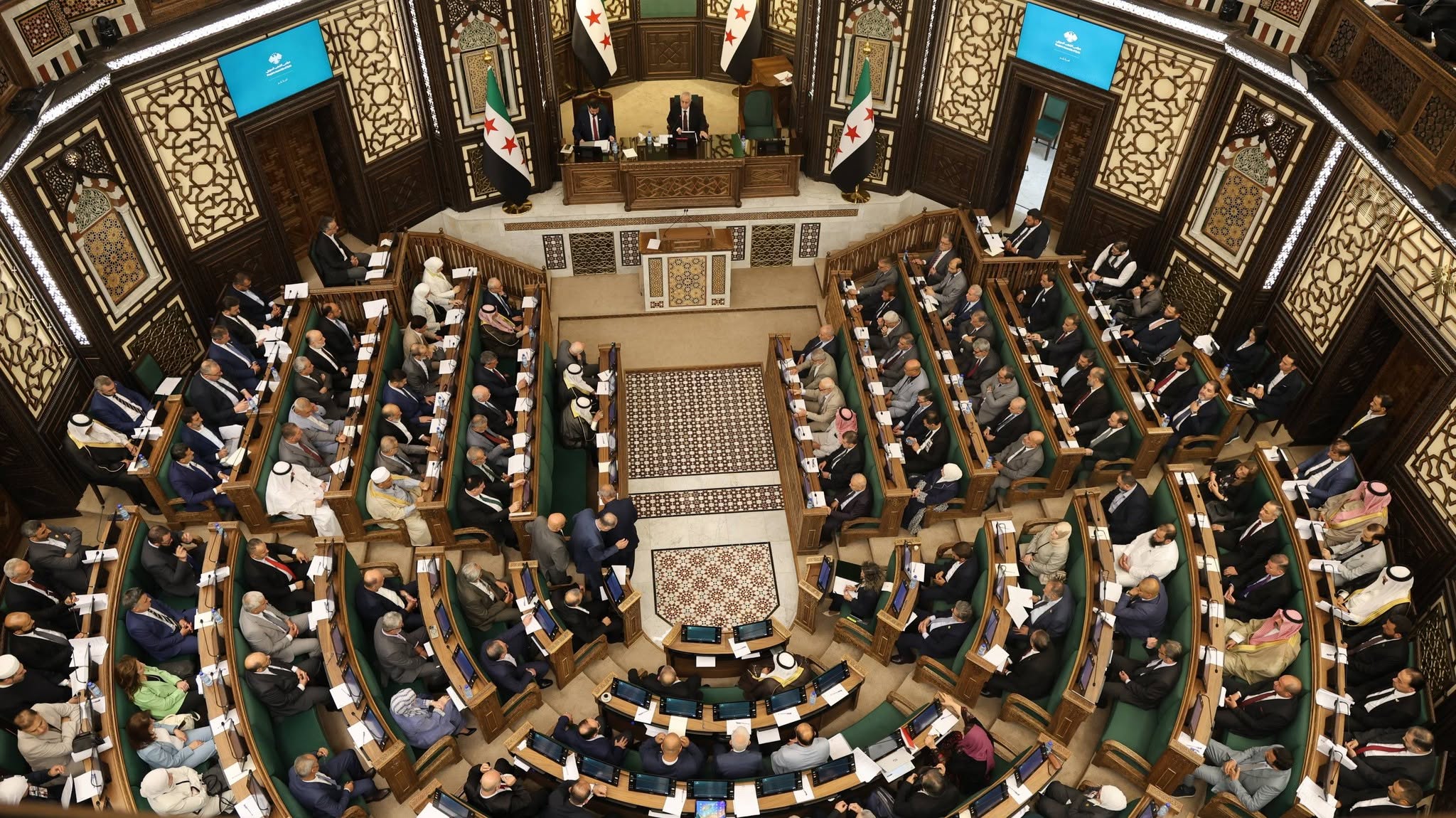





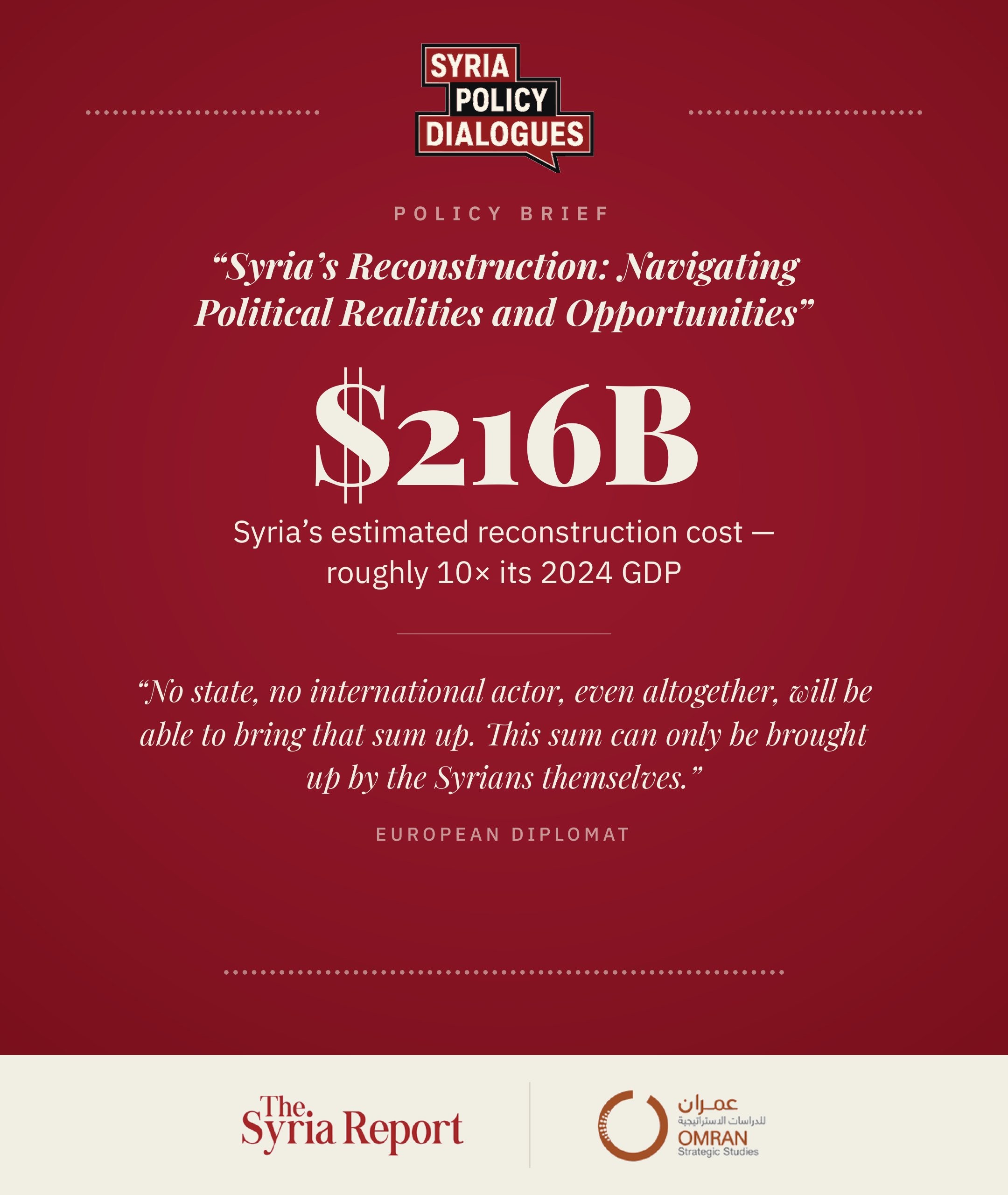

On 16–17 May 2026, The Syria Report convened the inaugural workshop of the Syria Policy Dialogues initiative in Damascus, in collaboration with the Omran Center for Strategic Studies. Titled “Syria’s Reconstruction: Navigating Political Realities and Opportunities,” the two-day closed-door workshop brought together a diverse group of Syrian and international participants under Chatham House Rules to examine the political dimensions of Syria’s reconstruction challenge.
Participants included Syrian bankers and financial sector representatives, businesspeople and industrialists, economists, urban planners, agricultural specialists, political analysts, lawyers, civil society representatives, and researchers. On the second day, the workshop expanded to include officials from key Syrian Ministries including Foreign Affairs and Expatriates, Finance, Economy and Industry, Energy, Local Administration, and Agriculture, as well as representatives from the General Establishment for Social Housing, the Syria Development Fund, and the Planning and Statistics Commission. The final session brought together diplomatic representatives from several key European and international states actively engaged in Syria’s reconstruction process.
The workshop proceeded from a central premise: reconstruction in Syria is not a technical or economic exercise alone but a deeply political process with direct implications for the trajectory of Syria’s political transition, the distribution of power and resources, and long-term social stability. Across five sessions, participants examined the governance and legal architecture required for credible reconstruction, the roles and responsibilities of key actors, housing as a politically sensitive domain, the relationship between reconstruction and equity, and the conditions governing international financing.
The following are the workshop’s principal findings:
- Syria is moving through overlapping early-recovery and initial reconstruction activities. The institutional, legal, and political foundations for large-scale reconstruction—including fully operational legislative and oversight bodies, a coherent legal framework, and an operational national reconstruction strategy—are not yet in place.
- Reconstruction policy is currently being shaped by investment logic rather than a national plan. The absence of a unified Syrian vision risks allowing market dynamics to determine priorities, concentrating benefits in commercially attractive urban centres while neglecting conflict-affected and rural areas.1
- Housing, land, and property rights constitute one of the most politically sensitive dimensions of reconstruction. Unresolved ownership disputes, informal settlements covering 30–40 percent of the pre-war housing stock,² and a largely frozen real estate market create a fertile environment for social injustice and the unequal distribution of reconstruction benefits.
- Syrian state institutions, amid reduced resources and accumulated damage over the years of conflict, face financial and institutional constraints and weak inter-institutional coordination, limiting their current ability to manage reconstruction independently. Nevertheless, the state’s role as regulator, planner, and guarantor of equity remains indispensable.3
- Workshop participants described the banking and financial sector as currently unable to support reconstruction at the required scale. Several public banks face financial and operational difficulties, international banking engagement remains limited, and gaps in the financial architecture constrain other dimensions of recovery.
- International financing will be essential but cannot substitute for a Syrian-led reconstruction strategy. The EU’s €15 million Technical Assistance Hub and broader €620 million support package represent significant steps,4 but effectiveness depends on Syrian institutional readiness and legal reform.
- Transitional justice is not an obstacle to reconstruction but a precondition for its durability. Economic justice — including accountability for economic crimes under the former regime and equitable distribution of benefits — must be embedded from the outset.5
- Agriculture and rural development were identified as the highest-priority productive sectors for reconstruction, given their potential for broad-based employment and their importance to the approximately half of Syria’s population living outside major urban centres.6