







Introduction
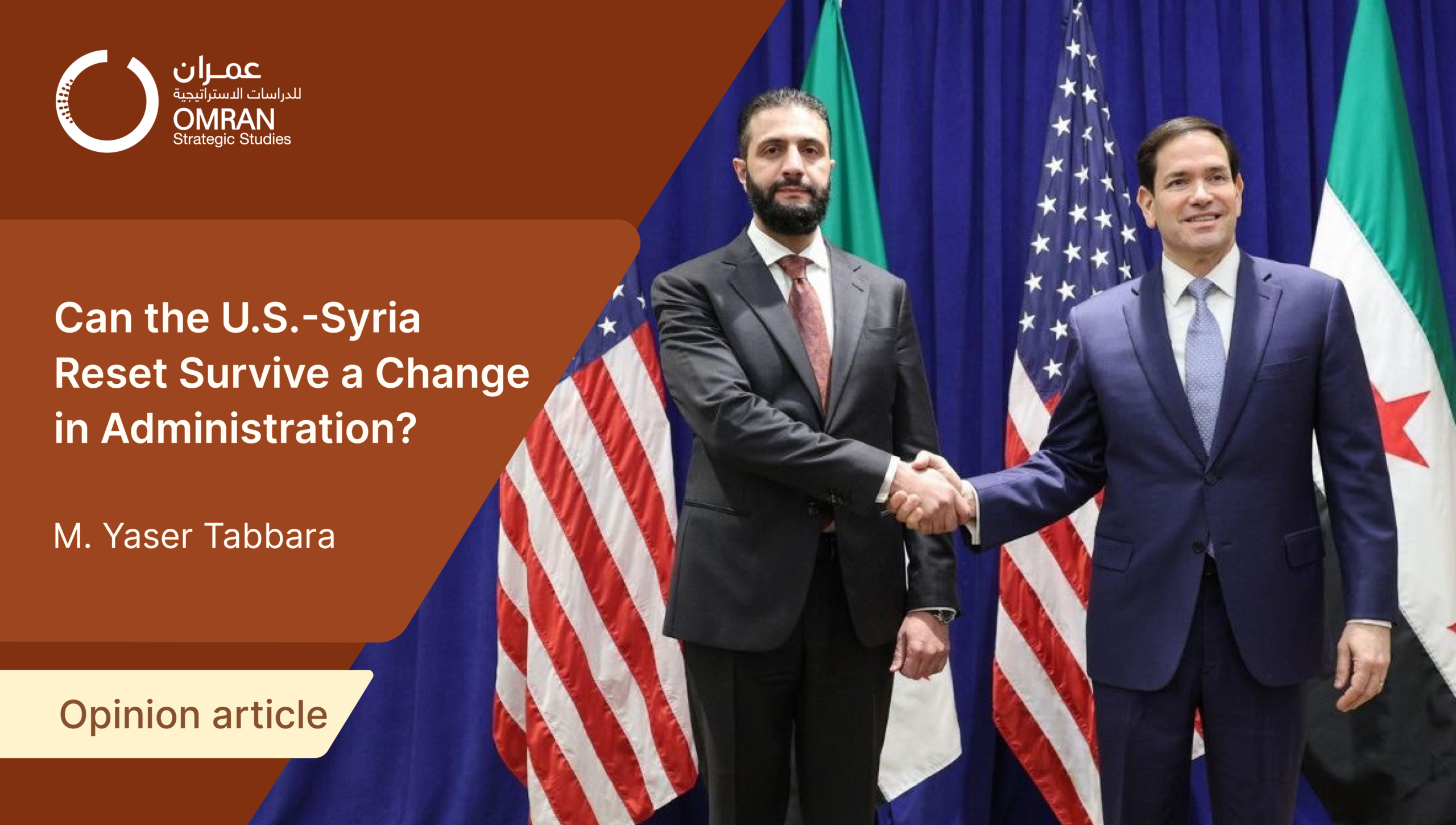
The Trump administration has done something in Syria that would have been difficult to imagine only two years ago: it has fundamentally reset the relationship between Washington and Damascus. The United States has removed the sanctions architecture that had constrained Syria for years, repealed the Caesar Act, removed Syria from the State Sponsors of Terrorism list, established direct engagement with President Ahmed al-Sharaa’s government, and begun treating Syria’s economic recovery as something in which American companies can potentially have a stake.
The question now is whether that reset can survive the political cycle in Washington. Syria is rebuilding after years of war and isolation. It cannot afford to make its economic recovery, security relationships or international reintegration dependent on the political fortunes of one American president. Washington has an interest in the same durability. If the United States has concluded that a stable, economically viable and internationally connected Syria serves American interests, then it needs a policy that can survive changes in administrations.
The Reset Is Real. But Is It Institutionalized?
There are already signs that the relationship is becoming bigger than the White House.
Consider Senator Jeanne Shaheen’s meeting with al-Sharaa in New York last month. Though retiring soon, Shaheen is the Democratic ranking member of the Senate Foreign Relations Committee, not a member of the Trump administration. Yet she welcomed the repeal of Caesar, Syria’s removal from the State Sponsors of Terrorism list and the prospect of responsible American and allied investment. At the same time, she emphasized inclusive governance, protection of ethnic and religious communities, women’s participation, continued cooperation against ISIS and the full implementation of the agreement integrating the Syrian Democratic Forces into the Syrian state.
That tells us something important about where Washington is going. The debate is no longer simply whether the United States should engage Syria. There is increasingly a bipartisan discussion about what that engagement should look like and what expectations should accompany it.
The recent Atlantic Council conversation between al-Sharaa and Brett McGurk was revealing in a different way. McGurk, who served under presidents of both parties, moderated the September 22 discussion in New York. Though the exchange was not particularly substantive, what stood out was how often the discussion returned to questions about al-Sharaa’s past, the composition of Syria’s security forces and other issues that Damascus has already been asked to address repeatedly.
Still, McGurk’s presence mattered. It brought an older Washington establishment into a conversation with a Syrian leadership that is now dealing with Washington on very different terms. Perhaps the Syrians’ insisting on McGurk is an indication that they recognize Washington as a spectrum rather than just the current administration.
Barrack, Congress and the Personality Problem
Tom Barrack has played an unusually important role in getting Washington and Damascus to this point. His personal diplomacy, his relationship with the Syrian leadership and his willingness to approach the relationship in transactional rather than purely ideological terms have helped move things forward quickly.
But that also creates a vulnerability.
A foreign policy that becomes closely identified with one envoy or one president is harder to sustain than one that has developed institutional support. Barrack’s role is especially relevant because the midterm elections are now approaching. On November 3, Americans will elect the next Congress, and a change in the balance of either chamber would change the oversight environment surrounding the administration’s foreign policy. Reuters notes that the results will determine whether the administration faces a Congress with greater capacity to investigate and scrutinize its policies during Trump’s remaining two years.
For Barrack, that could mean greater congressional scrutiny of how the Syria policy is being implemented, particularly given how central his role has become. That should not automatically be read as opposition to the policy itself. Congress has already played an important role in sanctions relief. It simply means that Syria is becoming too consequential to remain primarily a presidential file.
For Damascus, the lesson is straightforward: Washington needs to become bigger than Tom Barrack.
Syria should be building relationships across the American system — with Republicans and Democrats in Congress, the State Department, Treasury, the business community and the broader foreign-policy establishment. Barrack can remain an important channel. He should not be the channel on which the relationship depends.
Don’t Assume the Next President Will Be a Democrat
There is another assumption that needs to be avoided: that the alternative to Trump is necessarily a Democratic administration.
It isn’t.
The next White House could be Republican or Democratic, and either could approach Syria differently from the current administration. A Republican successor might retain the broad strategic logic of Trump’s Syria policy while being less personally invested in the relationship. A Democratic administration could maintain sanctions relief and engagement while placing greater emphasis on governance, human rights, minority protection or other conditions.
The debate already taking shape inside the Democratic Party illustrates the range. Alexandria Ocasio-Cortez is among the nationally discussed figures around the 2028 cycle, although she is currently weighing a possible Senate run as well as a presidential bid. Other figures being discussed for the Democratic future, including Josh Shapiro and others, represent very different political and foreign-policy instincts.
The point is not to predict who will emerge. It is to recognize that a change in Washington could change the assumptions behind the relationship even if the United States’ basic interest in a stable Syria remains.
That is why Damascus should prepare for continuity without assuming it.
Israel Is the Hardest Test
The most difficult test of the U.S.-Syria reset may ultimately be Israel.
Syria’s relationship with Washington cannot be separated from the latter’s with Israel. The question is whether the United States can help establish a sustainable Syrian-Israeli security arrangement without allowing Syria’s emerging relationship with Washington to become primarily a mechanism for managing Israeli concerns.
The issue is bigger than any individual Israeli strike. Israel has maintained military positions inside Syrian territory since the fall of the Assad government and has continued military operations in southern Syria. A recent U.N. Commission of Inquiry described the Israeli military presence and activity as increasingly sustained and entrenched, while Israel has maintained that its actions are necessary for its security and that it has no territorial ambitions.
From Damascus’s perspective, sovereignty cannot be treated as a secondary issue simply because Israel has security concerns. From Israel’s perspective, the collapse of the old Syrian security order created uncertainty along its northern border. Washington is one of the few actors capable of addressing both realities at the same time.
That makes the U.S. role particularly important. If Washington wants Syria to become a stable regional state, it should help create a framework in which Israeli security concerns, Syrian sovereignty and regional stability are addressed together. Otherwise, Syria risks becoming a country whose security environment is defined permanently by the concerns of others.
The Northeast Is No Longer an Issue
For years, Washington’s Syria policy was heavily organized around the relationship with the Syrian Democratic Forces (SDF). That framework has now changed. On August 25, the SDF formally announced the end of its independent military mission as part of its integration into the Syrian state. The United States had described the integration agreement as a major step toward Syrian national unity.
That does not mean every question has been resolved. The implementation of the settlement, representation of Kurdish communities, local administration and the protection of rights will continue to matter. But the basic political direction is different: the United States is no longer dealing with northeast Syria as a semi-separate security architecture.
This gives Washington an opportunity to carry its relationships and institutional knowledge from the northeast into a broader relationship with the Syrian state. It also gives Damascus an opportunity to demonstrate that national integration can coexist with meaningful local governance and protection of Kurdish rights.
The Real Test May Be Economic
Ultimately, likely, the durability of the reset will be decided less in Washington’s foreign-policy circles than in banks, boardrooms and investment committees.
Sanctions relief changes the legal environment. It does not automatically establish correspondent banking relationships, create investor protections, eliminate compliance concerns or persuade American companies that Syria is a market in which they can operate with confidence. The August 24 U.S. actions of removing Syria from the State Sponsor of Terrorism list were a major step precisely because they removed some of the most significant formal barriers to economic engagement.
The next phase is much less dramatic and much more difficult: banking, investment, corporate structures, regulatory institutions, infrastructure and trade.
That may actually be Syria’s strongest insurance policy against a future change in Washington.
Political relationships can change quickly. Commercial relationships are harder to unwind once companies have invested capital, banks have established relationships and institutions have developed an interest in keeping those relationships alive. If American companies become genuinely invested in Syria’s recovery, the U.S.-Syria relationship acquires constituencies that do not disappear when a president leaves office.
This is also where Syria has the most work to do. The removal of sanctions creates an opportunity, not a guarantee. The Syrian authorities now have to build the legal and regulatory environment that allows international capital to enter without creating new forms of political or economic vulnerability.
Damascus Should Prepare for Washington After Trump
The strategic lesson for Damascus is therefore fairly simple: do not build the American relationship around Donald Trump. Build it around American interests.
A stable Syria that is economically connected to the United States, capable of controlling its territory, cooperating against terrorism, reducing the space for Russia and Iran, and contributing to regional stability is an argument that can be made to both parties. The conditions attached to that relationship will probably change from one administration to another. The underlying argument does not have to.
This is also why Syria’s domestic institutional development has become inseparable from its foreign policy. The stronger the legal system, the more predictable the investment environment, the more capable the state institutions and the more credible the political arrangements, the less Syria has to depend on personal relationships in Washington.
The United States has already made the difficult decision to reset its relationship with Syria. Can that reset become an American policy rather than a Trump policy? Can Damascus build enough institutional, economic and political substance into the relationship that a future administration — Republican or Democratic — sees continuity as serving its own interests?
The Trump administration has changed the starting point. Syria’s task now is to make sure that the relationship that follows is too consequential, and too deeply rooted in mutual interests, to be easily reversed.