





Executive Summary
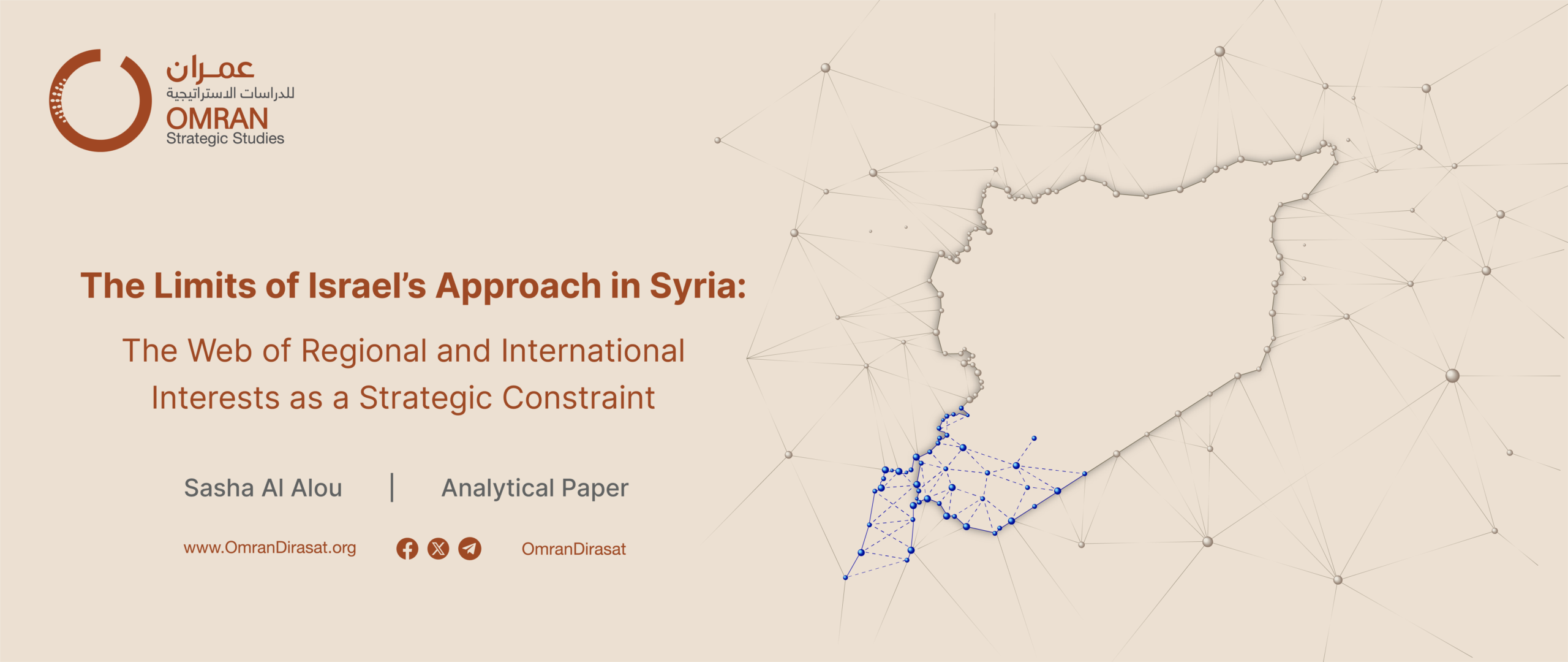
- This paper represents the second phase of an Omran Center research project that began with a quantitative and qualitative study of 416 Israeli operations targeting Syria in 2025. That study sought to unpack Israel’s evolving approach after the fall of the Assad regime. Building on its findings, this paper examines the limits of Israel’s ability to translate that approach into durable political and security arrangements. It proceeds from the premise that having a clear approach does not necessarily mean being able to impose it, and that understanding its limits requires moving from the analysis of Israeli behavior to the regional and international environment that shapes the prospects for its realization.
- The paper argues that the limits of Israel’s approach in Syria are no longer determined by the military balance alone, but by a complex web of regional and international interests. Despite Israel’s military and operational gains after Assad’s fall, it faces a broad set of overlapping interests tied to Syria’s stability. These interests constrain Israel’s ability to convert its gains into durable political and security arrangements.
- To test this hypothesis, the paper examines the positions and interests of regional and international actors engaged in Syria across three levels: Syria’s neighboring states, the broader regional environment, and major international powers. It argues that the constraints facing Israel’s approach do not stem from an anti-Israel alliance, but from a convergence of interests among actors with different motives and priorities. To varying degrees, these actors share an interest in preventing Israeli military superiority from becoming political and security arrangements that reshape the future of Syria and the region according to Israel’s vision.
- Syria’s neighboring states — Turkey, Jordan, Iraq, and Lebanon — have redefined Syria’s position and function after Assad’s fall. Despite differences in their national priorities, their interests converge around stability and the rejection of renewed security vacuums and fragmentation. This makes them the first circle of direct and indirect constraints shaping the limits of Israel’s approach in Syria.
- These constraints also extend to the broader regional environment, including the Gulf states, Egypt, and Iran. Following the decline of Iranian influence, no vacuum emerged that would allow Israel to capitalize on its military superiority and shape the region according to its post–October 7 security outlook. Instead, a web of interests and coordination frameworks concerned with Syria’s stability and reintegration has emerged — both as part of filling the vacuum and reshaping regional balances, and as a condition for protecting those interests.
- This transformation also extends to international powers, particularly the United States, Europe, and Russia. Despite their differing priorities, their positions show that Israel’s room for maneuver is shaped not only by balances of power, but also by Syria’s place within a broader web of interests in which security, economic, energy, and strategic competition considerations overlap. The wider this web becomes, the more the ability of any single actor to shape the Syrian landscape unilaterally declines.
- The future of Israel’s approach in Syria will not be determined by military superiority alone, but by Israel’s ability to adapt to a changing regional and international environment. This gives the new Syrian authorities an opportunity to strengthen their negotiating position vis-à-vis that approach. However, the success of this opportunity depends on their ability to position themselves within the emerging web of regional and international interests, and to consolidate internal stability and legitimacy in ways that can turn external convergences into sustainable political and security gains.
For More: https://bit.ly/4cdW9uh