






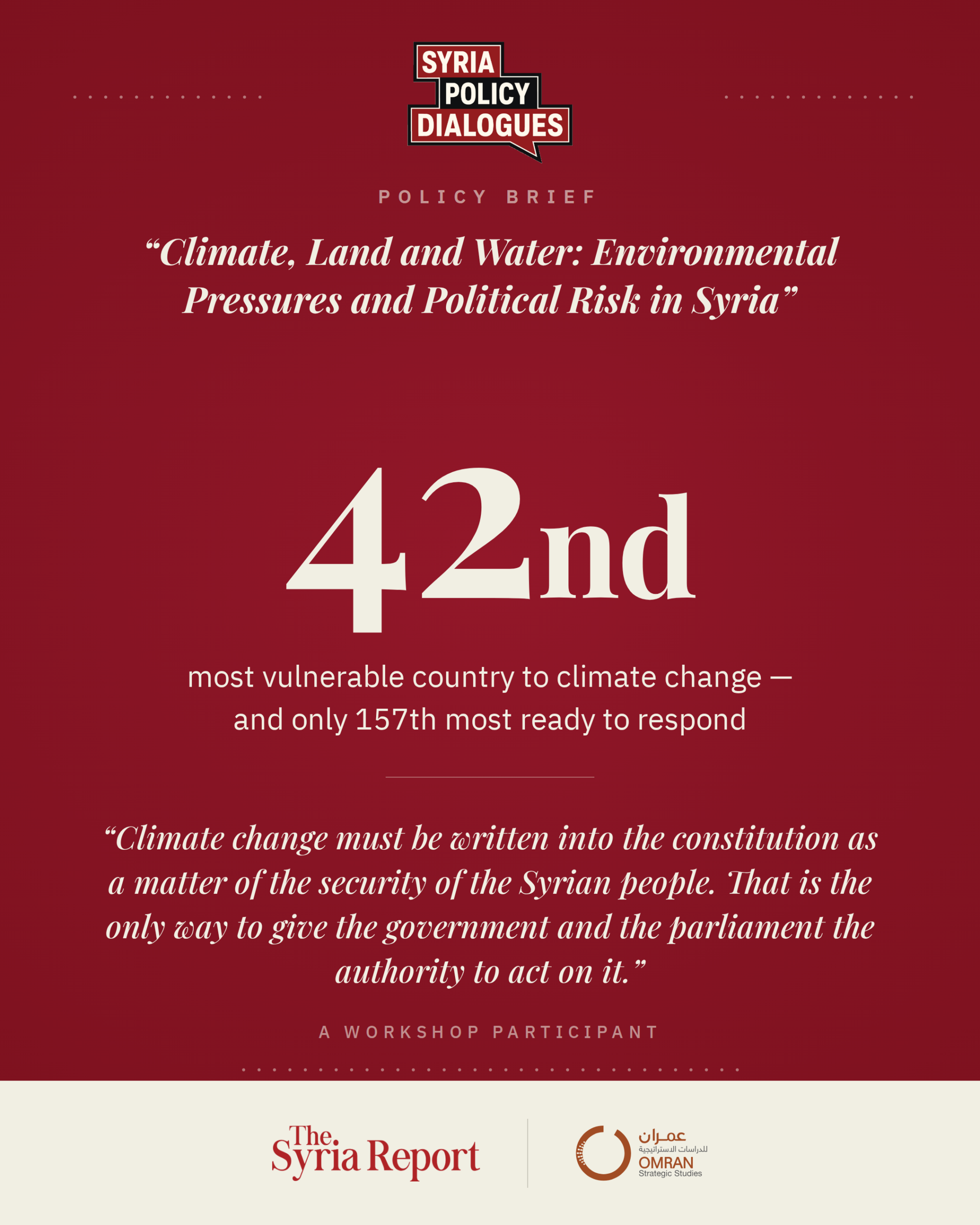

On 18 and 19 July 2026, The Syria Report convened its second workshop of the Syria Policy Dialogues
(SPD) initiative in Damascus, in collaboration with, and with the support of, the Omran Center for
Strategic Studies. Titled “Climate, Land and Water: Environmental Pressures and Political Risk in Syria,”
the two-day workshop brought together a diverse group of stakeholders under the Chatham House
Rule to examine how climate, water and land degradation impact Syria’s political transition.
Participants included climate experts and advocates, water specialists, agricultural and food security
experts, and environmental engineers drawn from national and regional scientific bodies, alongside
officials from the relevant ministries and representatives from international agencies and diplomatic
missions.
The workshop proceeded from a central premise: that Syria’s environmental pressures should be
understood not only as technical challenges, but as political risks bearing on stability, legitimacy and
the return of the displaced. Many participants argued that Syria’s difficulties reflect governance
constraints as much as resource scarcity. Across five sessions, each designed to open a theme and let
the discussion follow the expertise in the room, participants examined climate as a political risk, the
domestic and transboundary dimensions of water, land and food security, the institutional and legal
architecture of environmental governance, and the conditions governing international climate
finance.
The following themes summaries the workshop’s principal areas of discussion and broad
convergence; they do not imply unanimity among participants on every point:
Participants broadly agreed that environmental pressures remain insufficiently integrated into
the frameworks guiding Syria’s transition. The movement from severe drought to destructive
Euphrates floods within a single year was repeatedly cited as an illustration of how
environmental shocks can generate political pressure.
–Syria’s water challenge was described as a crisis of governance as well as scarcity, marked by
dispersed ministerial responsibilities, uneven enforcement, and major gaps in monitoring and
data.
–Water emerged as a question of national security. Around half of Syria’s water crosses an
international border before it arrives, tying the country’s water security to its most sensitive
relationships, from the Euphrates and Turkey in the north to the Yarmouk and the Israelioccupied dams of the south.
–Agricultural resilience was tied closely to political stability. Nearly half of the rural population
depends on farming, wheat was repeatedly described as a political red line, and participants
raised concerns about farmland degradation and the terms under which foreign agribusiness
may expand.
–Syria’s environmental governance, participants noted, has not kept pace with the scale of the
challenge. Environmental policy sits inside a broad administrative ministry with limited
convening authority over other sectors, legislation is fragmented across decades of
disconnected laws and decrees, and unlike the 2012 constitution, the current Constitutional
Declaration contains no reference to the environment.
–On climate finance, participants argued that the international system often favours countries
with stronger institutional capacity, potentially placing vulnerable, low-capacity countries such as Syria at a disadvantage. They viewed Syria’s first Green Climate Fund grant as an important
opening, while noting that the available sums remain modest and are implemented through
international partners.